
Week seven of flower. Scouting turns up russet mite damage on the upper leaves, and overnight humidity has been sitting higher than you would like. Every effective product in the cabinet carries a pre-harvest interval that runs past your chop date. This is the moment that decides whether a crop makes grade — and for a licensed GACP operation, the paperwork consequence of spraying the wrong thing is worse than the pest itself.
The way out is not a stronger product. It is having a contact layer already built into the programme: something with no pre-harvest interval, no residual and no resistance group, that you can reach for at any point in the cycle. Below: the twelve targets it covers, how to recognise each one, and the three things that decide whether it actually works.
The twelve targets — and what to look for
Contact products built from oils, plant soaps and food-grade acids work on soft-bodied insects, mites and surface fungal pathogens. That is a real boundary, not marketing language — anything with a hard cuticle falls outside it.

Spider Mites
Fine stippling on upper leaf, webbing in the crotches. Turn the leaf over — they live underneath.

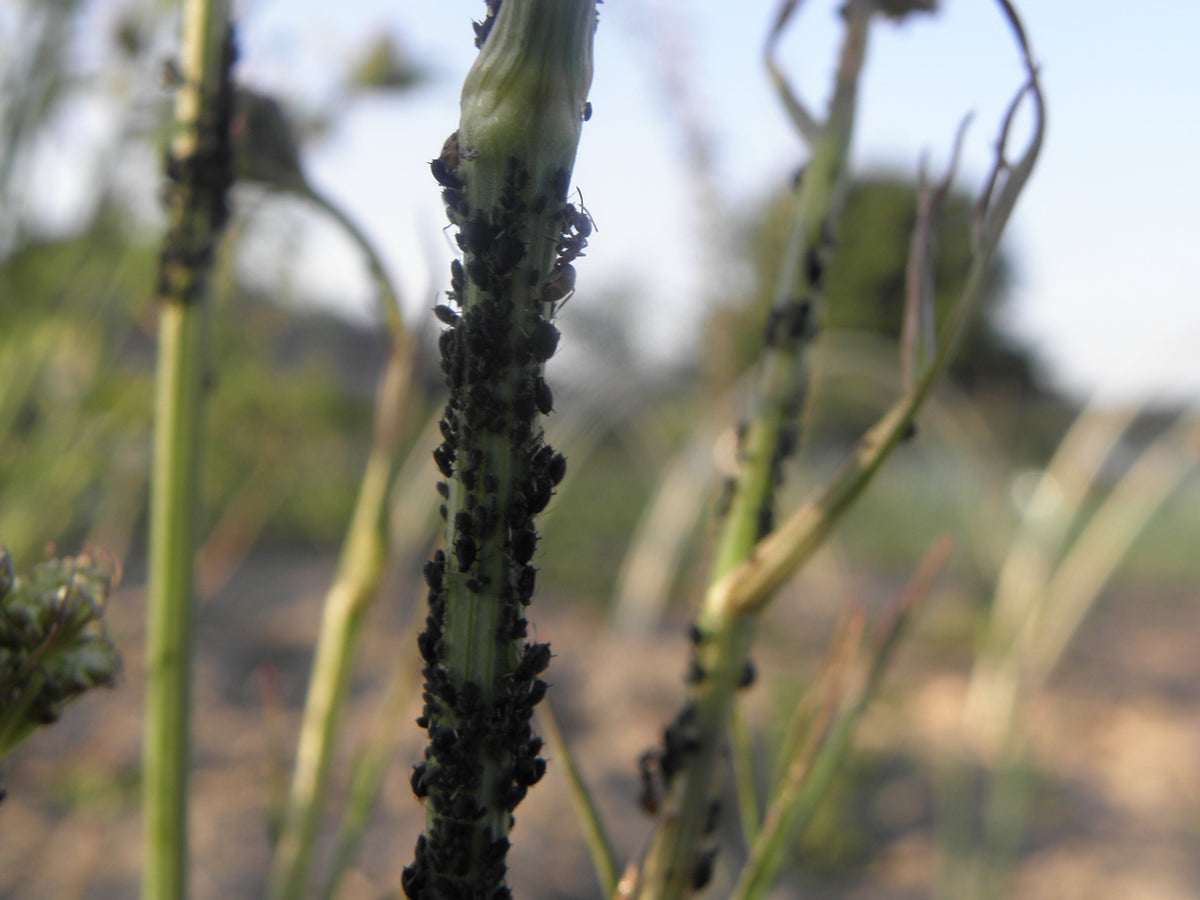
Aphids
Dense clusters on new growth and stems. Sticky honeydew below, often with ants working it.

Thrips
Silvery feeding scars with black frass specks. Slim, fast, drops when disturbed.

Mealybugs
White waxy cotton-like masses in leaf joints and along stems. The wax repels water — coverage must be deliberate.
Russet Mites
Microscopic. You see the damage first: stunted, glossy, curled new growth. By then the population is large.

Fungus Gnats
Small dark flies walking on the medium surface. The damage is done by larvae in the root zone — drench, do not spray.

Whiteflies
Lift off in a cloud when you brush the canopy. Nymphs sit still on leaf undersides — that is the stage that matters.

Powdery Mildew
Flat white talc-like patches that start small and spread along the leaf. Thrives on still air and wide day-night humidity swings.

Botrytis
Grey fuzz inside dense flower, brown collapsing tissue. Starts where a bud cannot dry — pull it and check the core.

Scale Insects
Immobile bumps fixed to stems, often mistaken for plant tissue. Only the mobile crawler stage is reachable.

Psyllids
Jumping plant lice. Waxy white threads and distorted shoot tips are the usual tell.

Leafhoppers
Wedge-shaped, move sideways, jump instantly. Pale stipple damage plus the risk of what they carry between plants.
Also covered by the same mechanism: broad mites, hemp aphid, root aphid, cabbage moth, pill bugs, leaf rust and general mould. The manufacturer notes that the smaller the organism, the faster the formula acts — larger soft-bodied insects take longer and may need repeat application.
One: intervals beat concentration
The most common programme failure is arithmetic, not product choice. A contact spray kills what it touches on the day it is applied. It does not reach eggs tucked into leaf folds, and it leaves nothing behind to catch what hatches tomorrow.
A two-spotted spider mite goes from egg to egg-laying adult in roughly seven to ten days in a warm room. Spray once and you remove the mobile stages present that afternoon; the eggs hatch on schedule and you are back where you started, having concluded the product does not work. Spray every two to three days at the low rate for one to two full cycles, then drop to weekly maintenance, and you close the life cycle. Raising the concentration instead of the frequency buys leaf stress and the same result.
Two: coverage is the whole product
A contact product treats exactly the surfaces the droplets land on. Three places sprays reliably miss — and all three are where the pests live:
- Leaf undersides. Mites and whitefly nymphs sit there. Spraying from above treats the wrong side of the leaf.
- Interior canopy. A dense, un-defoliated canopy shadows its own centre. Nozzle pressure does not solve geometry.
- The medium. Fungus gnat larvae and root aphids are never reached by a foliar pass — they need a drench at the same rate.
So: spray from below and from the side as well as above, work the stems, and accept that a canopy you cannot get a nozzle into is a canopy you cannot treat. Defoliation and plant spacing are part of the spray programme, not separate from it.
Three: the rotation slot nothing else can fill
Resistance management works by alternating modes of action — which is why IRAC and FRAC assign every conventional active a group number. Repeat the same group and you select for the survivors.
A product that works mechanically — coating and suffocating the organism, dehydrating it, shifting leaf-surface pH — has no biochemical site of action to adapt around, and therefore belongs to no IRAC or FRAC group at all. Slotted between your conventional passes it resets selection pressure instead of adding to it, and it protects the actives you actually depend on. Any agronomist building a resistance plan will recognise what an ungrouped mode of action is worth in a rotation.
The trial data, and what it does not say
Trials run by Cornell University's College of Agriculture and Life Sciences on tomato, melon, hemp and lettuce reported 96% +/- efficacy against powdery mildew — leaf-disease scores over 14 days plus Area Under Disease Progression Curve — and 95% +/- efficacy against total western flower thrips and all soft-bodied insects, from feeding-damage ratings, on-plant counts and a final shake test. Calculated with Abbott's formula, analysed by ANOVA and Tukey's HSD.
Two honest qualifications. These figures are as published by the manufacturer of Lost Coast Plant Therapy; the underlying study is not posted publicly and we have not reviewed the raw data. And a trial figure is obtained under trial discipline — correct intervals, full coverage, controlled conditions. It describes the ceiling available to a well-run programme, not a result the product delivers on its own.
The detail that catches people out in Thailand
Oil-based contact sprays carry a temperature ceiling: do not apply above 80 °F / 27 °C. In central and northeastern Thailand that rules out most of the day for most of the year. Spray at first light or at dusk; indoors, apply under low light and let the canopy dry fully before lights return. Nearly every case of leaf burn we are asked to diagnose turns out to be a correct rate applied at the wrong hour.
Where this leaves a GACP programme
A contact layer does not replace sanitation, airflow, humidity control, scouting or your conventional chemistry. It fills one specific gap: the intervention you can still make late in flower without creating a residue question, a re-entry restriction or a pre-harvest interval your file cannot absorb. Set the interval to the pest's life cycle, get the nozzle where the pest lives, and slot it between your grouped actives.
Lost Coast Plant Therapy® is the contact layer we supply for this role — a natural 3-in-1 insecticide, fungicide and miticide built on food-grade soy oil, peppermint oil and citric acid, usable to the day of harvest, in 1 L, 4 L and 10 L ex-warehouse Bangkok. Manufacturer Safety Data Sheets are published on the product page. For the full spray programme by target organism, Department of Agriculture documentation and the certificate of analysis for your specific lot, message us on our LINE Official Account — issued per customer in the form your GACP auditor needs.
See also: all Lost Coast Plant Therapy sizes · plant protection range
Image credits. The two disease photographs show Cannabis sativa and are reproduced under the Creative Commons Attribution 4.0 International licence (CC BY 4.0), cropped but otherwise unaltered. Powdery mildew: Punja ZK, Collyer D, Scott C, Lung S, Holmes J, Sutton D (2019) Pathogens and molds affecting production and quality of Cannabis sativa L. Frontiers in Plant Science 10:1120, Figure 7B — doi:10.3389/fpls.2019.01120. Botrytis: Buirs L, Punja ZK (2024) Integrated management of pathogens and microbes in Cannabis sativa L. under greenhouse conditions. Plants 13(6):786, Figure 14e — doi:10.3390/plants13060786. Every remaining identification photograph is in the public domain or released under CC0 and carries no attribution requirement; we credit the photographers anyway. Spider mite (Tetranychus urticae): Daniel Das, iNaturalist, CC0. Aphids (Aphis fabae): Rob Hille, public domain. Thrips (Frankliniella occidentalis): Jesse Rorabaugh, iNaturalist, CC0. Mealybugs: V. Matvєєva, CC0. Fungus gnat (Sciaridae): Bj.schoenmakers, CC0. Whitefly (Bemisia tabaci): Stephen Ausmus, USDA Agricultural Research Service, public domain. Scale insects (Lepidosaphes ulmi): Randal, iNaturalist, CC0. Psyllid: USGS Bee Inventory and Monitoring Lab, public domain. Leafhopper (Cicadella viridis): Bj.schoenmakers, CC0. In that second group the species shown are representative of each pest category and the host plants pictured are not cannabis. A russet mite reference photograph is being sourced — the mite is microscopic and no open-licence image shows it usefully.